What Was to Be Expected: The Negotiations in Islamabad Failed
Fundamental analysis
2026-04-12 22:57:07
Even before the start of the negotiations in Islamabad, I said that the likelihood of achieving a peace agreement was minimal. Negotiations between Iran and the US had been ongoing even before the start of the war in the Middle East. If the parties had any real chance of reaching a deal, it would have been achieved without gunfire and missile launches. The cornerstone issue prior to the war was Iran's nuclear energy. Washington demanded that Tehran abandon any nuclear developments, including peaceful ones, as well as agree to the export of all enriched uranium stocks out of Iranian territory. Iran responded with refusals in January and February 2025, and over the last 50 years. What were the odds that in March 2026, Tehran would suddenly agree to abandon nuclear developments? As I anticipated, zero.
In March 2026, a second cornerstone issue arose: the Strait of Hormuz. Tehran finally used its trump card in its confrontation with the US. However, this trump card affected the entire world, but Iran's strategy is simple and effective. Firstly, closing the Strait of Hormuz would cause an energy crisis worldwide. Except for those countries that have sufficient oil and gas. Even in the US, which does not suffer from a shortage of energy resources, inflation is rising, and the economy is slowing down. Consequently, even America cannot feel good under the current circumstances. Thus, Tehran has effectively taken the world hostage, demonstrating that if it weren't for US aggression, no one would have any problems with oil and gas.
Secondly, Iran is now earning two or even three times more from its own oil exports. Oil prices have risen, and export volumes have increased amid a general shortage. Therefore, the Strait of Hormuz has not only affected the entire world but has also brought Tehran triple profits. I certainly cannot say that Iran wants to continue fighting to sell more oil at higher prices, but Iran understands that it has a joker that no one else in the conflict possesses. Therefore, Iran will not give up this joker easily. The US position in the negotiations has not changed: abandonment of nuclear developments and the opening of the Strait of Hormuz. Iran was not ready to meet either condition without clear concessions from the US. And how Donald Trump knows to concede is probably something everyone already knows...
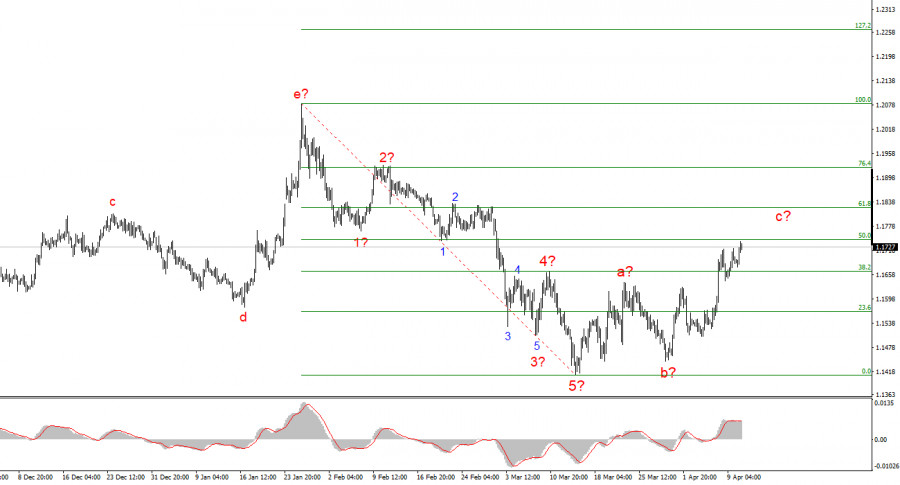
Wave Picture for EUR/USD:
Based on the analysis of EUR/USD, I conclude that the instrument remains within an upward segment of the trend (bottom picture), while in the short term, within a corrective structure. The corrective wave pattern appears quite complete and can take on a more complex, elongated form in only one case: if a lasting ceasefire is established between Iran, the USA, Israel, and ALL other countries in the Middle East. Otherwise, I believe that a new downward wave pattern may begin from the current positions.
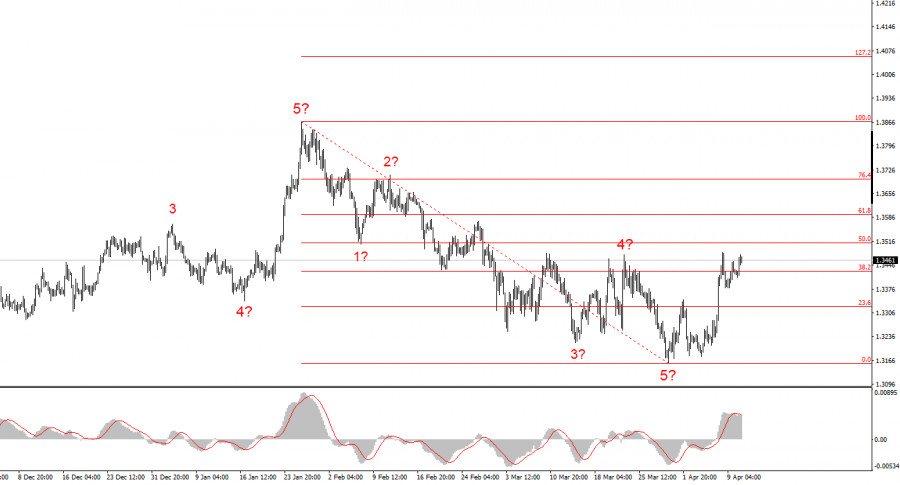
Wave Picture for GBP/USD:
The wave picture of the GBP/USD instrument has, over time, taken on a clearer form, as I had assumed. Now we see a clear five-wave downward structure with an extension in the third wave on the charts. If this is indeed the case, and geopolitics does not cause a new crash of the instrument in the near future, then we can expect the formation of at least a three-wave corrective structure, within which the pound may rise to levels of 1.3511 and 1.3594, corresponding to 50.0% and 61.8% Fibonacci levels. If a ceasefire is achieved, the corrective segment of the trend may turn into an impulsive one.
Key Principles of My Analysis:
- Wave structures should be simple and clear. Complex structures are difficult to trade and often involve changes.
- If there is no confidence in market developments, it is better not to enter the market.
- There is never 100% certainty in the direction of movement. Always remember to use protective stop-loss orders.
- Wave analysis can be combined with other types of analysis and trading strategies.
Смотрите также