What Was to Be Expected: The Negotiations in Islamabad Failed. Part 2
Fundamental analysis
2026-04-12 22:57:19
US Vice President JD Vance reported this morning that the negotiations failed and that the US delegation is returning home without an agreement. Initially, it was reported that the negotiations would last all Sunday, but as I mentioned, what is there to negotiate when the positions of Iran and the US are at completely opposite ends of the universe? Iranian representatives stated that Washington's demands were excessive but nonetheless indicated that negotiations could be possible in the future. Now, we must wait for Donald Trump's statement, who threatened to launch a new devastating strike against Iran if the negotiations failed. I will reiterate that Tehran is aware of the strength of its own negotiating position, so it will not concede.
JD Vance also stated that the American delegation clearly outlined the red lines, indicating where concessions were possible and where they were not. However, according to the Vice President, the Iranian side rejected the proposed conditions. Therefore, as I have stated throughout this week, a ceasefire exists only on paper. Now that the negotiations have failed, new missiles could fly toward Iran at any moment. What is the point of sticking to the ceasefire when the Strait of Hormuz remains closed, the negotiations have failed, and Iran is not willing to abandon its nuclear weapons?
On the other hand, representatives of Pakistan stated that the negotiations were quite constructive, calling for adherence to the ceasefire and continuity of dialogue at the highest level. In Israel, it was reported that the two-week ceasefire has not yet expired, so negotiations could still resume. The Iranian Foreign Ministry also expressed cautious optimism, stating that it was unlikely an agreement would be reached in just one negotiation session. According to a representative of the Iranian Foreign Ministry, the parties found mutual understanding on some issues, but there are still two or three key points remaining. I have mentioned these "two or three key points" more than once.
By the way, the third stumbling block could be Lebanon, which Israel continues to strike. In Jerusalem, they stated that they fully support the two-week ceasefire, but Lebanon is not participating in it. Iran demands that all strikes against Hezbollah in Lebanon be halted.
Based on all of the above, I believe that the likelihood of reaching an agreement is virtually zero, now, in a month, or in a year. We can only hope for the most likely scenario: Trump will announce total victory, American troops will leave the Persian Gulf, and Iran will open the Strait of Hormuz, charging any ship that passes through, especially tankers. This is currently the most realistic scenario for ending the war.
Wave Picture for EUR/USD:
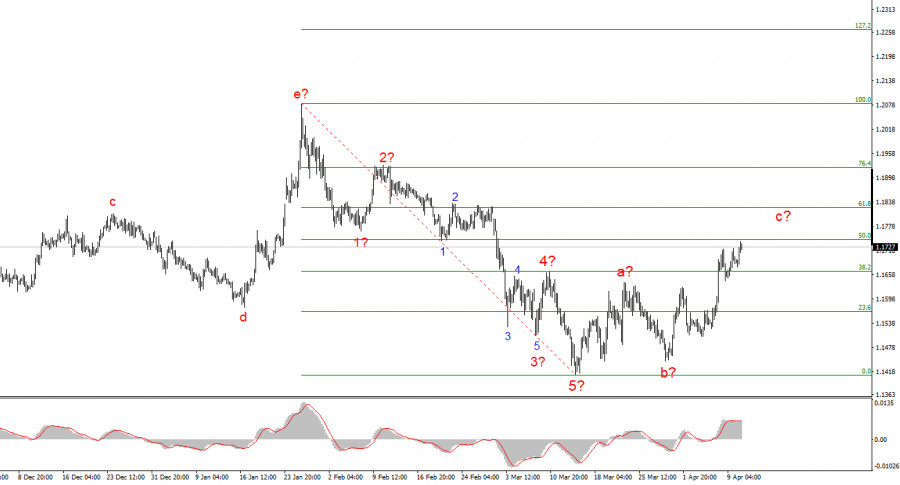
Based on the analysis of EUR/USD, I conclude that the instrument remains within an upward segment of the trend (bottom picture), while in the short term, within a corrective structure. The corrective wave pattern appears quite complete and can take on a more complex, elongated form in only one case: if a lasting ceasefire is established between Iran, the USA, Israel, and ALL other countries in the Middle East. Otherwise, I believe that a new downward wave pattern may begin from the current positions.
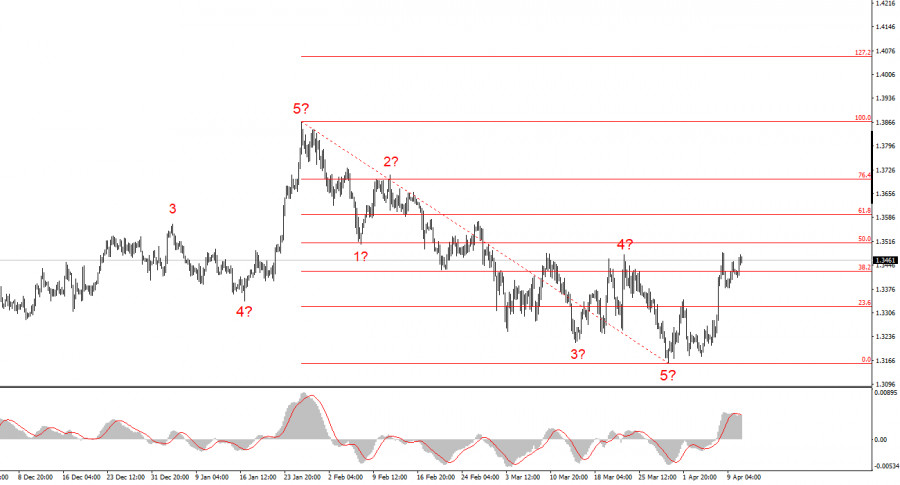
Wave Picture for GBP/USD:
The wave picture of the GBP/USD instrument has, over time, taken on a clearer form, as I had assumed. Now we see a clear five-wave downward structure with an extension in the third wave on the charts. If this is indeed the case, and geopolitics does not cause a new crash of the instrument in the near future, then we can expect the formation of at least a three-wave corrective structure, within which the pound may rise to levels of 1.3511 and 1.3594, corresponding to 50.0% and 61.8% Fibonacci levels. If a ceasefire is achieved, the corrective segment of the trend may turn into an impulsive one.
Key Principles of My Analysis:
- Wave structures should be simple and clear. Complex structures are difficult to trade and often involve changes.
- If there is no confidence in market developments, it is better not to enter the market.
- There is never 100% certainty in the direction of movement. Always remember to use protective stop-loss orders.
- Wave analysis can be combined with other types of analysis and trading strategies.
Смотрите также