EUR/USD Review on July 3: Euro Weakness Against the Dollar
Fundamental analysis
2026-07-03 09:28:26
The EUR/USD currency pair once again attempted to resume its upward movement on Thursday, and only the Nonfarm Payrolls report made that possible. The euro spent most of the current week moving sideways, and yesterday's session did not significantly change the overall technical picture. Let us briefly recall the current setup. From our point of view, the latest phase of dollar weakness and, consequently, euro strength was illogical, unfounded, and unjustified. The market largely ignored the ECB's rate hike in June, the end of the Middle East conflict, falling oil prices, and other factors. Almost the entire macroeconomic backdrop of recent months has been disregarded. The only exception has been U.S. Nonfarm Payrolls reports. Since recent movements were illogical, we may now be seeing their continuation.
On Wednesday, leading global central bankers spoke at an economic forum in Portugal. The heads of three key central banks (the Bank of England, the Federal Reserve, and the ECB) delivered speeches, and the market will now rely on and reference their statements. What did Christine Lagarde say? It should be recalled that earlier Ms. Lagarde supported several ECB rate hikes, as "the energy crisis has damaged the EU economy in any case, and inflation has moved far away from the target level and cannot return to it on its own." Accordingly, the ECB was inclined toward tightening policy in July.
However, Lagarde's latest speech showed that the ECB may change its stance if inflation continues to slow. In June, the Consumer Price Index fell to 2.8%, not far from the 2% target. If inflation continues to decline for a couple more months, why would the ECB continue tightening? It is also worth noting that the euro declined even while the ECB was raising rates. If the ECB abandons further tightening, what could happen to the euro? Correct — it could decline even further.
However, we should remember that current market movements cannot be called logical, and the Federal Reserve may also abandon further tightening (which has already largely been priced in) if U.S. inflation begins to decline on its own. Kevin Warsh is a protege of Donald Trump, and the U.S. President is unlikely to welcome interest rate hikes. Of course, Warsh will not make rate decisions alone, but he may influence the Monetary Committee to avoid rushing into tightening policy. He may cite examples from the EU and the UK, where inflation has begun to decline without regulatory intervention. Over time, inflation may return to target levels. We believe the Fed will, at minimum, delay tightening for as long as possible, which (again) has largely already been priced in. Thus, ironically, a more dovish ECB stance could actually support the euro, because the dollar continues to dominate market direction. And the dollar still lacks a strong long-term growth foundation.
Moreover, the daily timeframe clearly shows that the pair is trading near its two most recent lows, and the entire price action over the past year can essentially be considered a range. Therefore, it is possible that we are at the very beginning of a prolonged new rise in the euro.
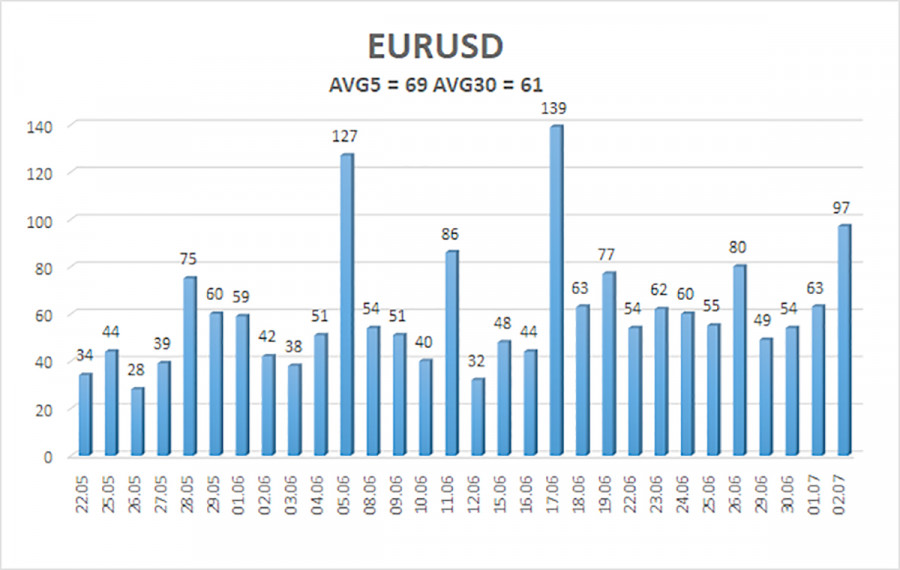
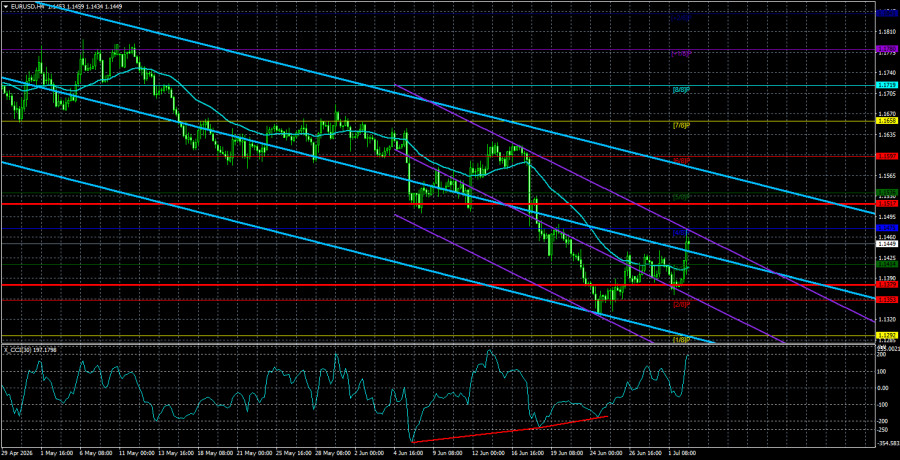
The average volatility of the EUR/USD pair over the last five trading days as of July 3 is 69 points, classified as "moderate." We expect the pair to trade between 1.1379 and 1.1517 on Friday. The higher linear regression channel has turned downward, indicating a continuation of the bearish trend. The CCI indicator entered oversold territory and formed two bullish divergences, signaling a possible end of the downward trend.
Nearest support levels:
- S1 – 1.1414
- S2 – 1.1353
- S3 – 1.1292
Nearest resistance levels:
- R1 – 1.1475
- R2 – 1.1536
- R3 – 1.1597
Trading recommendations:
The EUR/USD pair maintains a bearish trend, which is likely a correction within a broader long-term uptrend, as clearly seen on the daily and weekly timeframes. The long-term fundamental background for the dollar remains negative, but in 2026, first geopolitics and then the Fed's hawkish stance provided strong support to the U.S. currency. When price is below the moving average, short positions can be considered with targets at 1.1353 and 1.1292. Above the moving average, long positions become relevant with targets at 1.1517 and 1.1536. Bears are currently extremely strong without any clear justification.
Explanation of charts:
- Linear regression channels help determine the current trend. If both are pointing in the same direction, the trend is strong.
- Moving average (settings 20.0, smoothed) defines the short-term trend and trading direction.
- Murray levels are target levels for price movements and corrections.
- Volatility levels (red lines) represent the expected price range for the next 24 hours based on current volatility.
- CCI indicator: movement below -250 (oversold) or above +250 (overbought) signals a potential trend reversal.
Смотрите также