analytics1_1
Interpretation of the GBP/USD Analysis Results for October 27. Bad Examples Are Contagious
Interpretation of the GBP/USD Analysis Results for October 27. Bad Examples Are Contagious
Trading plan
2026-10-27 03:50:30
Analysis GBP/USD 5M
The GBP/USD pair traded lower on Monday, despite no strong fundamental or macroeconomic reasons for the pound to fall. The current decline appears to be a technical correction after a fairly strong rally. The question now is whether this is just a correction or the start of a prolonged dollar advance. As long as the price remains above the Senkou Span B line, the uptrend can be considered intact. However, the euro continues to fall almost without corrections and may pull sterling down with it. It would be crucial for the pound to break any linkage with the euro because sterling looks much more resilient versus the dollar. It has a positive technical picture on the daily and weekly timeframes that supports a rise at least to 1.3650. But if the market rushes to buy the dollar again for any reason, nothing may save the pound. Unfortunately, this week the market could interpret almost any Federal Reserve outcome as dollar-positive, even if the U.S. central bank does not raise the key rate and Kevin Warsh does not announce further policy steps. Right now the dollar needs very little to rise.
Technically, sterling continues forming a new uptrend. A correction is possible, but the pair must not drop below Senkou Span B—if it does, the uptrend can be considered invalidated.
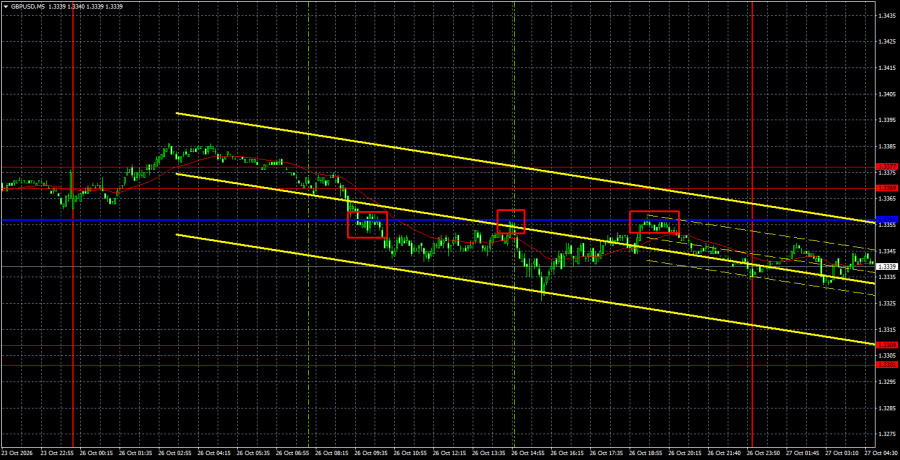
On the 5-minute TF, three sell signals formed on Monday. The price first closed below the 1.3369–1.3377 area and the Kijun-sen line, then bounced twice off that critical line from below. Thus, traders had the opportunity to open short positions, which could develop further on Tuesday with targets around 1.3301–1.3309.
COT report
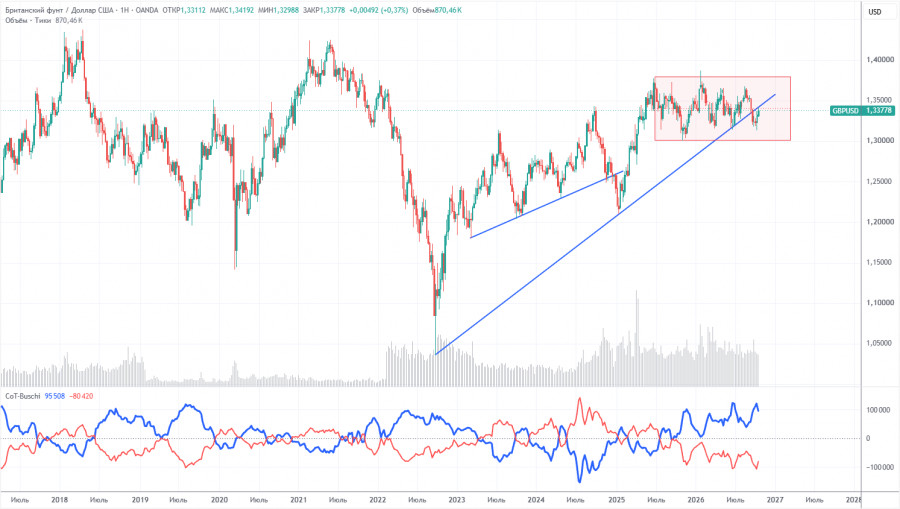
COT reports for the pound show that non-commercial traders have dominated selling for several months. The net position is negative despite the long-term uptrend persisting. Given events in the Middle East, it is unsurprising that dollar demand remains high in 2026. The U.S.–Iran war is formally on pause but could resume soon. The Fed's changed monetary stance also supports the dollar, and the ascending trend line was breached; however, it was broken amid a flat, so we do not consider the uptrend complete.
In the long term, the dollar continues to weaken due to Donald Trump's policies, which is clearly visible on the weekly TF. Trade tensions will persist in one form or another for a long time, and Trump's policies aim, directly and indirectly, to weaken the U.S. currency. The long-term uptrend remains intact. According to the latest COT report (dated October 20), the "Non-commercial" group opened 10,000 BUY contracts and closed 16,500 SELL contracts. Thus, the net position of non-commercial traders increased by 26,500 contracts over the week.
Analysis GBP/USD 1H
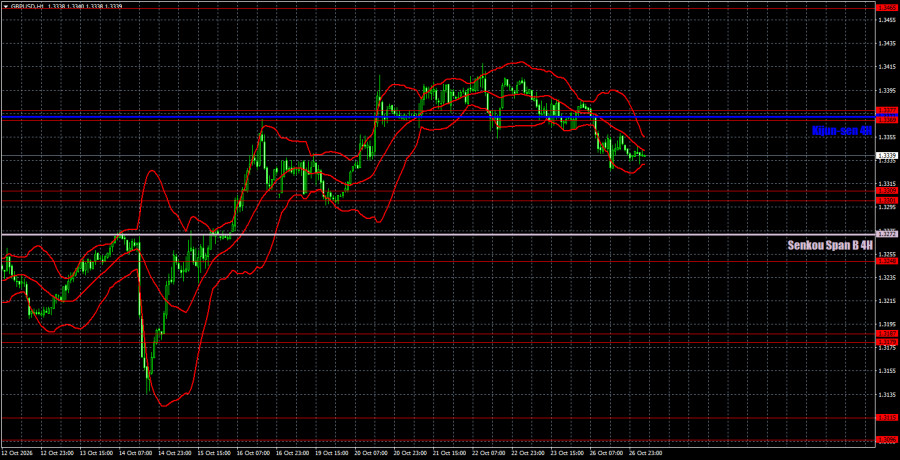
On the hourly timeframe, GBP/USD continues to form a logical and consistent uptrend. On the daily and weekly TFs, the price cleared liquidity from recent lows and remained inside sideways channels. Therefore, one can expect the pound to rise at least to the 1.3650 level, the upper boundary of the sideways channel on the daily chart. Reasons for the pound's rise are not required, just as reasons were not required for the dollar's rise last month.
For October 27 we highlight the following important levels: 1.3042–1.3050, 1.3096–1.3115, 1.3179–1.3187, 1.3248, 1.3301–1.3309, 1.3369–1.3377, 1.3465–1.3480, 1.3588, 1.3671–1.3681. The Senkou Span B line (1.3272) and the Kijun-sen (1.3372) can also provide signals. It is recommended to move the Stop Loss to breakeven after the price moves 20 pips in the right direction. Ichimoku lines may shift during the day, so take that into account when determining trading signals.
Today no important events or releases are scheduled in the UK, while the U.S. will publish a relatively important durable-goods orders report that may attract market attention — though it is unlikely to dominate the agenda given the more significant events ahead.
Summary of the above analysis:
Traders can consider the 1.3301–1.3309 area as a target for short positions after a hold below the 1.3357–1.3377 area. A rebound from the 1.3301–1.3309 area allows considering 1.3369–1.3377 as a target for long positions.
Explanations for the illustrations:
- Price support and resistance levels (resistance/support) — thick red lines around which movement may end. They are not sources of trading signals.
- Kijun-sen and Senkou Span B lines — Ichimoku indicator lines transferred to the hourly timeframe from the 4-hour timeframe. They are strong lines.
- Extreme levels — thin red lines from which the price previously bounced. They are sources of trading signals.
- Yellow lines — trendlines, trend channels, and any other technical patterns.
- Indicator 1 on the COT charts — the size of the net position of each trader category.
Смотрите также