analytics1_1
Interpretation of the EUR/USD Analysis Results for October 28. The Euro Continues to Plunge
Interpretation of the EUR/USD Analysis Results for October 28. The Euro Continues to Plunge
Trading plan
2026-10-28 04:40:43
Analysis EUR/USD 5M
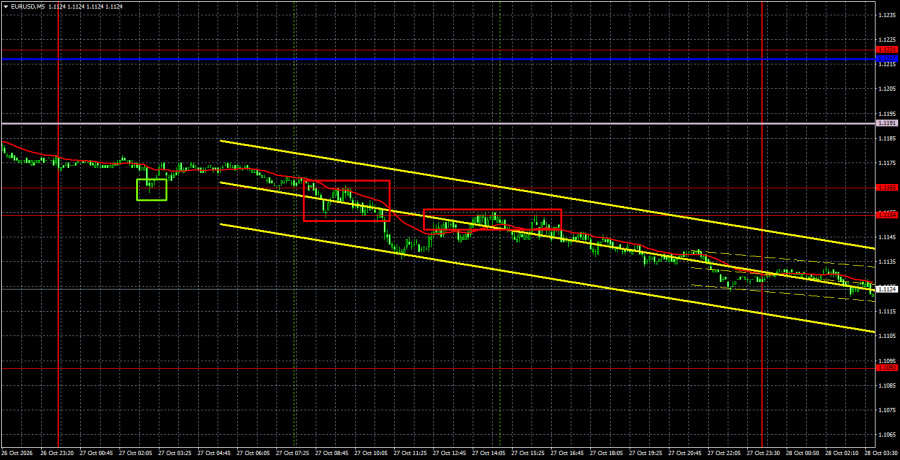
The EUR/USD pair continued to fall on Tuesday, moving ever lower. Formally, the euro managed a correction of roughly 100–120 pips before the new decline. We view that move not as a real correction but as a shallow pullback, weak relative to the current fundamental and macro backdrop. We do not believe the euro has adequate reasons to fall almost without correction for two months. Yet the market clearly sees it differently and keeps selling EUR/USD.
This week is especially telling. The European Central Bank and the Federal Reserve hold their penultimate meetings of the year, and both central banks are expected to deliver neutral decisions. Nevertheless, the U.S. dollar continues to strengthen as if the ECB were preparing to cut rates while the Fed were preparing to raise them. That is the paradox of the current move: the market is interpreting events and news in the dollar's favor. The Middle East war has not even resumed, and given Donald Trump and the TACO principle, it might not. Protests in EU countries have also calmed somewhat, so the euro's fall cannot be blamed solely on that factor. As for macro news, one relatively important release this week supported the dollar, but the dollar's rise hasn't been confined to that single report.
Technically, the downtrend could be considered complete because the trend line was breached. Still, the market looks prepared to keep offloading euros for a couple more months in favor of dollars. Price sits below the Ichimoku lines, so for now the trend can again be treated as downward.
On the 5-minute TF, two sell signals formed on Tuesday. Price first broke the 1.1154–1.1165 area, then bounced off it from below, giving traders at least two opportunities to open short positions. The decline can continue during the day. Only toward the evening might we see a reversal or heightened volatility due to the Fed meeting.
COT report
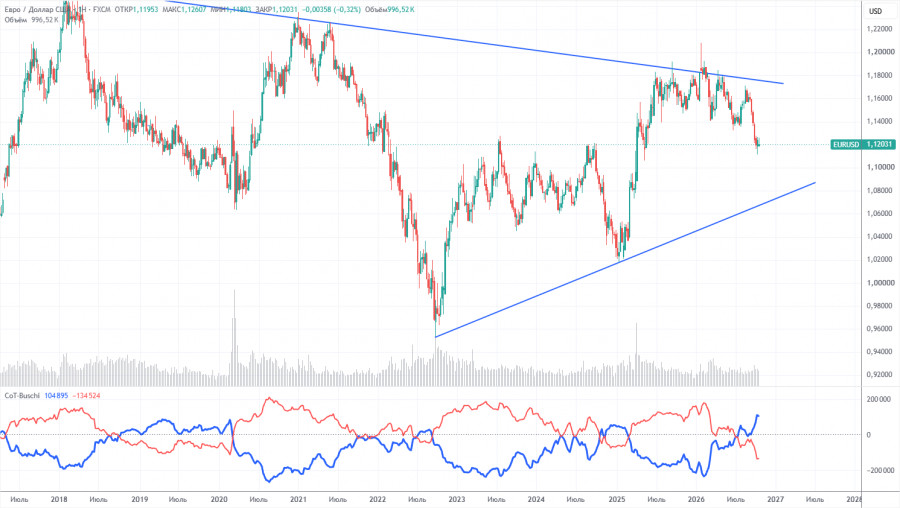
The latest COT report is dated October 20. On the weekly TF, non-commercial traders' net position remains clearly bearish and has declined significantly in 2026 due to geopolitical events. Over the past eight months, traders have been exiting the euro in favor of the U.S. dollar. Donald Trump's policies have not changed, but the dollar served as a reserve currency for a time.
However, we still do not see any fundamental factors that would further strengthen the U.S. dollar. The war in the Middle East made the dollar super-attractive for a while, and the Fed's monetary-policy stance surprised the dollar for the second time this year. In the long term, the euro could fall as low as $1.08 (the trend line), but the longer-term uptrend will remain relevant. Nevertheless, in recent weeks the market has priced in only positive factors for the dollar and ignored everything else.
The arrangement of the red and blue indicator lines points to the bears' advantage. During the last reporting week, long positions among the "Non-commercial" group rose by 3,500, while short positions increased by 500. Accordingly, the net position rose by 3,000 contracts over the week.
Analysis EUR/USD 1H
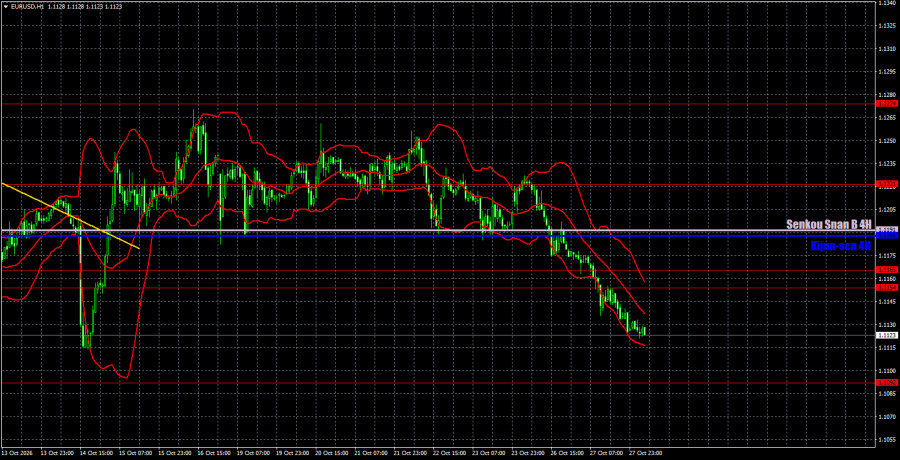
On the hourly timeframe, the EUR/USD pair finally has the opportunity to form an uptrend. If you also look at the daily and weekly timeframes, it becomes clear that the chances of a strong and lasting trend remain high. However, for the euro to rise, buyers must step in. Over the past two weeks, the market has shown no willingness to buy the euro. Therefore, based on market sentiment, we think a new decline is more likely, regardless of macroeconomics and fundamentals.
For October 28 we highlight the following levels for trading — 1.1092, 1.1154–1.1165, 1.1221, 1.1274, 1.1362–1.1368, 1.1461–1.1473, 1.1536–1.1542, 1.1585, 1.1657–1.1665, as well as the Senkou Span B line (1.1191) and the Kijun-sen (1.1188). The Ichimoku lines may shift during the day, so account for this when determining trading signals. Remember to move your Stop Loss to breakeven after the price moves 15 pips in the right direction. This will protect against possible losses if the signal turns out to be false.
The key event on Wednesday is the Fed meeting and Chair Kevin Warsh's post-decision remarks. Although the decision is expected to be neutral, the dollar has risen for four consecutive days, and any comments from Warsh tonight may be interpreted as supportive of the U.S. currency.
Summary of the above analysis:
Traders can consider short positions near 1.1092, since price has held below the 1.1154–1.1165 area. If price rebounds from 1.1092, consider long positions at 1.1154–1.1165 and the Ichimoku lines.
Explanations for the illustrations:
- Price support and resistance levels (resistance/support) — thick red lines around which movement may end. They are not sources of trading signals.
- Kijun-sen and Senkou Span B lines — Ichimoku indicator lines transferred to the hourly timeframe from the 4-hour timeframe. They are strong lines.
- Extreme levels — thin red lines from which the price previously bounced. They are sources of trading signals.
- Yellow lines — trendlines, trend channels, and any other technical patterns.
- Indicator 1 on the COT charts — the size of the net position of each trader category.
Смотрите также