EUR/USD Analysis – October 29: The Fed Meeting Results Were in Line with Expectations
Wave analysis
2026-10-29 05:32:39
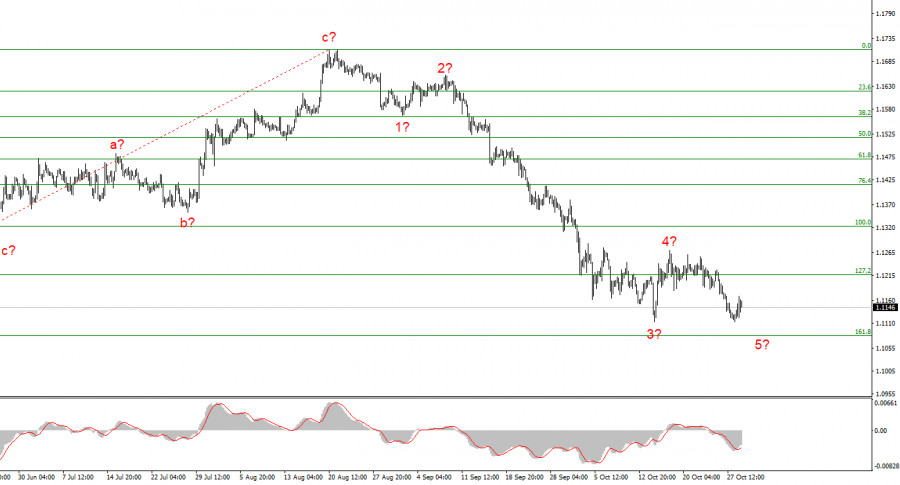
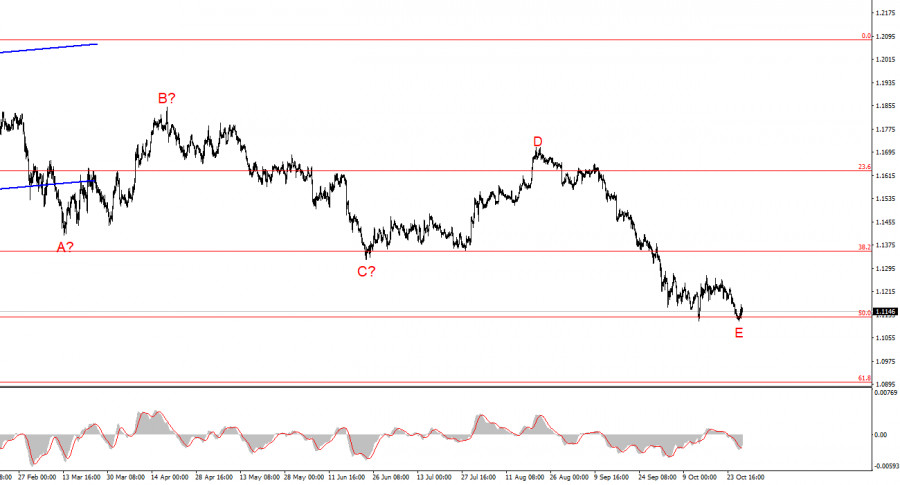
The wave count on the four-hour chart for EUR/USD has become more complex. On the higher time frame (bottom chart), the downward trend segment has taken the form of a five-wave A-B-C-D-E structure, which could be complete at any moment, as it appears well developed. All waves within this segment are approximately equal in size, so this structure is considered corrective. If this assumption is correct, a new impulsive upward trend segment will begin once the correction is complete, with targets well above the 1.2000 level.
On the lower time frame (top chart), an impulsive wave sequence is still developing and may belong to wave E of the higher time frame. If this is indeed the case, the US dollar's advance is nearing its end, regardless of how strongly it rises. The anticipated wave 5 within wave E is either complete or close to completion. In either case, the current wave structure suggests that the downward wave sequence is nearing completion on both charts. News developments and a sharp shift in market sentiment have driven a strong rally in the US dollar, but few new factors remain to support further gains in the currency.
The EUR/USD pair rose by 25 basis points on Wednesday, which, to be honest, looks rather ridiculous. Readers probably expected a strong rally, a sharp decline, or abrupt moves in both directions, just as I did, rather than such an entirely subdued reaction. By and large, the market delivered exactly the response the Fed meeting warranted. Interest rates remained unchanged, and Kevin Warsh provided no new information at the press conference, certainly making no announcement about the US central bank's future policy moves. Consequently, there was little for traders to react to. The lack of a significant market reaction was therefore entirely predictable.
At the same time, it is important to consider not only the market's reaction immediately after the meeting but also how market participants positioned themselves beforehand. Over the past few days and months, the market has consistently increased its purchases of the US dollar. What prompted this buying? More hawkish expectations regarding Fed policy, France's budget crisis, unrest in EU countries, and rising geopolitical tensions. The list could go on indefinitely, but did these developments really justify a decline in the euro throughout this period? After all, the ECB is also raising interest rates, demonstrations and protests against Donald Trump's policies regularly take place in the United States, the US budget deficit has become a familiar subject of debate, and geopolitical tensions have persisted throughout 2026. Is the news environment really so unfavorable for the euro that the market should continue to sell it? In my view, it is not.
The current wave count continues to suggest the development of a new upward trend segment across all time frames. This remains the primary scenario, as there appears to be little justification for further US dollar appreciation following its two-month advance.
General Conclusions
Based on the EUR/USD analysis, the pair remains within a global corrective trend segment labeled A-B-C-D-E. However, this structure appears fully developed and may therefore be complete. The current conditions appear favorable not only for buying the euro but also for anticipating a sustained upward trend segment. According to the higher time frame, the pair is expected to rise to at least the 1.1700–1.1800 level. The failed attempt to break below 1.1126, corresponding to the 50.0% Fibonacci level (bottom chart, higher time frame), also suggests that the market may be preparing for a recovery.
The higher time frame shows a downward trend segment in the form of an A-B-C-D-E structure. The internal wave structure of wave E has taken the form of a five-wave impulse, but this structure may already be complete. If this assumption is correct, a new upward trend segment will begin to develop.
The main principles of the analysis are as follows:
- Wave structures should be simple and easy to understand. Complex structures are difficult to trade and often involve changes in the expected market pattern.
- If there is no clear understanding of what is happening in the market, it is better to stay out.
- There can never be absolute certainty about the direction of price movement. Do not forget to use protective Stop Loss orders.
- Wave analysis can be combined with other types of analysis and trading strategies.
Смотрите также