analytics1_1
How to Trade the EUR/USD Pair on November 19? Simple Tips and Trade Review for Beginners
How to Trade the EUR/USD Pair on November 19? Simple Tips and Trade Review for Beginners
Trading plan
2026-11-19 02:54:08
Analysis of Wednesday's Trades:
1H chart of the EUR/USD pair
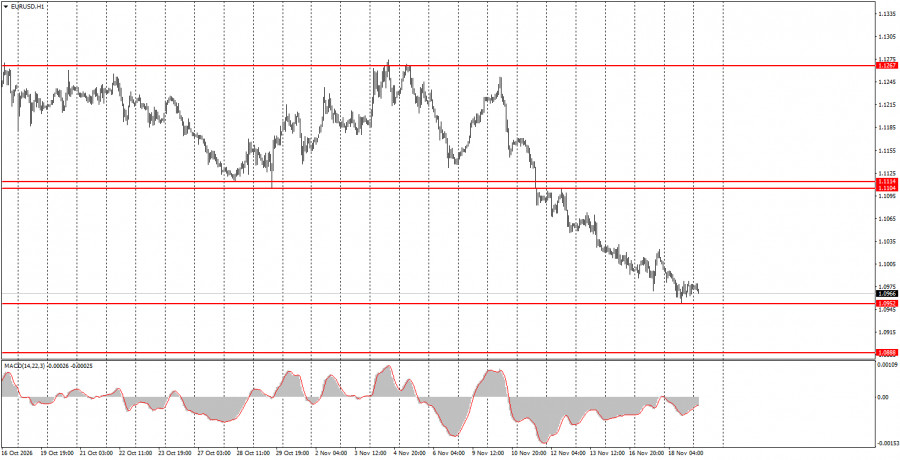
The EUR/USD currency pair continued its downward movement on Wednesday. Notable events included speeches by European Central Bank President Christine Lagarde, the minutes of the last Federal Reserve meeting, and the second-estimate eurozone inflation release. None of these seemingly "headline" events triggered any market reaction, as we warned. Lagarde speaks publicly quite often and cannot constantly provide traders with new or updated monetary-policy information several times a week. The second estimate of October inflation matched the first exactly, so there was nothing for traders to react to — and they ignored the first reading as well. Eurozone inflation has already risen to 4%, yet the euro has fallen for three months regardless of the ECB's hawkish stance. FOMC minutes are a purely formal event because they are published three weeks after the meeting; during that interval new data appear, so committee members' sentiment now can differ materially from their stance three weeks earlier.
5M chart of the EUR/USD pair
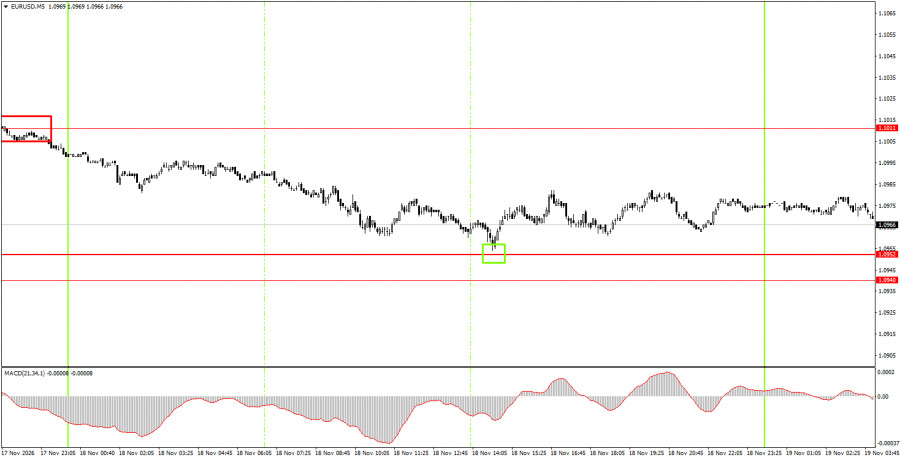
On the 5-minute TF, one buy signal formed on Wednesday. At the start of the US session, price rebounded from the 1.0940–1.0952 area and moved about 10–15 pips in the favorable direction by day's end. Market volatility remains low at present.
How to Trade on Thursday:
On the hourly timeframe, EUR/USD has resumed a downward trend that has lasted more than three months. The euro has not managed to correct properly in recent weeks. Considering events in recent months, we do not believe the euro had grounds for such a sharp drop with almost no correction. At the moment, the dollar is heavily overbought, and many factors favoring the euro are being ignored.
On Thursday, novice traders may consider new short positions if price consolidates below the 1.0940–1.0952 area, targeting 1.0888–1.0896. Long positions can be opened on a rebound from the 1.0940–1.0952 area, targeting 1.1011.
On the 5-minute TF consider the levels 1.0888–1.0896, 1.0940–1.0952, 1.1011, 1.1104–1.1114, 1.1198–1.1218, 1.1267–1.1275, 1.1366–1.1377, 1.1461–1.1474. On Thursday, ECB President Christine Lagarde will speak again, from whom we also do not expect any new information — and certainly not supportive comments for the euro. In the US, only the secondary weekly jobless claims report is scheduled. Volatility may remain low today.
Main rules of the trading system:
- Signal strength is judged by how long the signal took to form (a bounce or a breakout). The less time required, the stronger the signal.
- If two or more false signals have been generated around a given level, all subsequent signals from that level should be ignored.
- In a flat (range), any pair can produce many false signals or none at all. Technical levels can be ignored.
- On the hourly timeframe, ideally trade MACD signals only when volatility is strong, and a trendline or trend channel confirms the trend.
- If two levels are placed very close to each other (5–20 pips), treat them as a support/resistance area.
- After price moves 15 pips in the intended direction, move the Stop Loss to breakeven.
What is shown on the charts:
Price levels (areas) of support and resistance — levels that serve as targets when opening longs or shorts or as sources of signals.
Red lines — channels or trendlines that display the current trend and indicate the preferred trading direction.
MACD indicator (14,22,3) — histogram and signal line — an auxiliary indicator that can also be used as a source of signals.
Important speeches and reports (listed in the news calendar) can strongly affect a currency pair's movement. Therefore, when they are released, one should trade as cautiously as possible or step aside to avoid a sudden price reversal against the prior direction.
Beginner forex traders should remember that not every trade can be profitable. Developing a clear strategy and money-management rules is the key to long-term success in trading.
Смотрите также