Intraday Strategies for Beginner Traders on the Euro for November 24
Forecast
2026-11-24 06:21:49
Yesterday the euro's day was turned by remarks from John Williams of the New York Federal Reserve. While euro-area data were being released, the pair traded around 1.0972, then by the evening it had fallen to about 1.0882 — a roughly 90-pip loss. Overnight it recovered about 40 pips, rose to 1.0921 and now stands near 1.0910.
Williams said the job of returning inflation to 2% is not done. He emphasized the need for rate hikes at several meetings in succession if the economy proves stronger than expected or if gasoline keeps rising; in such cases one should not wait. The change in tone matters to markets. On Sept. 2 he had said there was no need to rush; on Oct. 14 he allowed for one hike in 2026 and none in 2027; on Nov. 17 he rejected abrupt moves. Now the same cautious official speaks of a series of hikes — and that carries more weight for the dollar than any single data point.
European data on Friday were mixed. The eurozone composite PMI was 51.7 (forecast 51.9, prior 51.7) — essentially unchanged. U.S. composite PMI fell to 54.6 (forecast 55.6, prior 55.9) — its weakest in four months. Nevertheless, the U.S. reading remains roughly three points above the eurozone reading, and the dollar simply ignored the data.
Today the euro could get a breather. Germany will publish the Ifo business-climate index for November, a company-survey gauge of current conditions and expectations. Consensus expects 90.5 after 90.2 in October; current-conditions at 89.2 (prev. 88.8); expectations at 92.0 (prev. 91.6). In October, climate beat forecasts but the current-conditions component disappointed. Friday's German PMIs argue for further improvement. If Ifo prints at least in line with consensus, the euro should get short-term support, but it likely won't last long.
Momentum
Now EURUSD stands at 1.0910, inside the range between 1.0884 and 1.0925, about 15 pips below the upper boundary and 26 pips above the lower. A move beyond the boundary is considered a breakout only after confirmation — several consecutive five-minute candles closing beyond the level — because a single poke proves nothing.
On the upside, 1.0925 is active. A confirmed close above it opens the way to 1.0963 and then to 1.1004. Overnight price only reached 1.0921 and stopped four pips short of the level, and yesterday evening it fell through that area, so for buyers this looks more like a ceiling. The first upside target, 1.0963, lies near Friday's low around 1.0958 — a level from which the euro already fell, so sellers are likely there. The second target, 1.1004, almost matches yesterday morning's high near 1.1006. Reaching it would require a strong catalyst; Ifo could provide one, but after Williams's comments, I have low conviction in such a surge.
On the downside, the reference is 1.0884; a confirmed close below it leads to 1.0848 and then to 1.0810. I treat this direction as primary. Yesterday's low near 1.0882 dipped two pips below the level but did not hold and bounced. For context: on November 10 the pair was near 1.1229; yesterday on data it was about 1.0972; yesterday evening about 1.0882; now 1.0910 — the overnight bounce recovered only about 28 of the roughly 90 pips lost earlier. It is about 26 pips to the lower boundary, and another 36 pips from there to the first downside target at 1.0848. If U.S. rhetoric and tomorrow's PCE confirm a hawkish path, a confirmed close below would produce a rapid drop. I would not enter on the first touch.
Mean Reversion
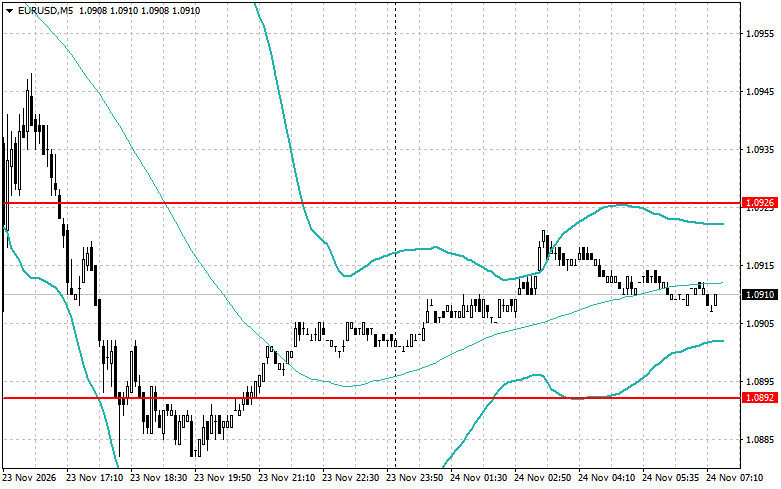
There are two levels here: 1.0926 and 1.0892. The upper reference, 1.0926, sits just one pip above the upside breakout point at 1.0925 and about 16 pips above current price, so the same zone functions as both a breakout marker and a mean-reversion zone; on the first touch, you cannot tell which scenario is active. If price consolidates above 1.0925, the breakout is in play, and you must not sell. If price reaches 1.0926, finds no continuation, and quickly returns below, I would consider selling toward 1.0892 with a stop above 1.0932 — i.e., above the breakout point with a small margin. That picture is likely if Ifo prints near consensus and the market retraces after the initial reaction. The difference between scenarios may take several minutes to clarify, so skip the first reaction in the zone.
The lower reference, 1.0892, lies eight pips above the downside breakout point at 1.0884 and about 18 pips below current price, so it would be hit before a confirmed break lower. Yesterday's low near 1.0882 was three pips below it, and price returned higher, so buyers have already appeared there. The scheme is this: price falls to 1.0892, cannot hold below and returns higher — then I look to buy toward 1.0926 with a stop below 1.0878, i.e., beneath yesterday's low and the breakout point with a margin. A buffer is essential because price often slips a few pips beyond levels. A rebound is likely if no new hawkish Fed comments appear. If price consolidates below 1.0884, the rebound is canceled, and the downward breakout to 1.0848 is in play.
Смотрите также